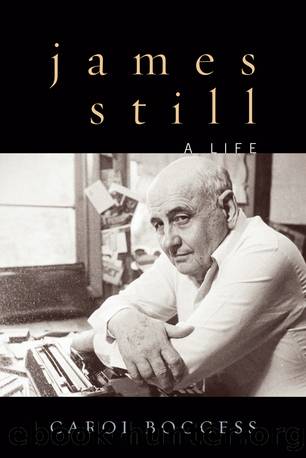
James Still by Carol Boggess
Author:Carol Boggess
Language: eng
Format: epub
Publisher: The University Press of Kentucky
Published: 2017-03-14T16:00:00+00:00
20
On to Morehead
What I am trying to do at Morehead State College is conduct reading courses ⦠in which students with genuine creative talent might discover themselves.
âJames Still
The year after Stillâs father died, Gurney Norman published his article in The Hazard Herald. Though the paperâs distribution was narrow and the interviewer inexperienced, the story revealed a theme central to Stillâs creative life: he wrote because it made him happy. In February 1960 Joe Creason, a staff writer for the Louisville Courier-Journal, explored the same theme. Creasonâs article âSome things a man does just for himselfâ covered three full pages in the magazine section and featured six photographs showing Still engaged in a variety of activities: flipping through manuscripts in an open trunk, filling a bird feeder, helping a student in the library, distributing books from the bookmobile, typing at his desk, and pruning bushes in front of his log house. Creasonâs original idea had been to write about the Hindman library.1 When they had first met at a Morehead Writersâ Workshop, Creason thought the bookmobile would make an interesting topic and serve as a reminder that the state should provide more money for books and libraries. He wanted to feature Still as the librarian.
The published article devotes only a couple of sentences to the bookmobile. It is all about James Still, the man and writer, complete with hyperbole and special emphasis on how different he is from the âtypical successful creative writer.â He does not make speeches, nor attend autograph parties, nor submit to publicity tricks. He does have manuscripts he has never submitted for publication, and he is practically indifferent to the payment he receives from the ones that are published. According to the article, Still was âa compulsive writer that writes because he must, not because it is a shortcut to gold and glory.â2 The title comes from Stillâs declaration âThere are some things a man does just for himself and nobody else.â This notion of a private pursuit and secluded lifestyle led Creason to label Still âa literary hermit.â The article helped establish the early persona that would become a major feature of Stillâs personality and values later in his career. Still never thought of himself as a literary hermit and sometimes recoiled at the description, yet that was the person he had projected to Creason.
The article led to numerous âfanâ letters. One was from Frank Gulledge, president of the Bank of St. Helens in Shively, Kentucky. He had been acquainted with Still years earlier when he was an office boy in the Fairfax mill. âKnowing you at that time and reading [Creasonâs] story yesterday, I donât think you have changed a bit.â The article generated several letters to the editor, and at least one reader, Polly Bing, was inspired to write directly to Still. She thanked him for letting Creason do the piece then gently reminded him that it is fine not to seek acclaim or money, but people should know more about him and his writing.
Download
This site does not store any files on its server. We only index and link to content provided by other sites. Please contact the content providers to delete copyright contents if any and email us, we'll remove relevant links or contents immediately.
The Vikings: Conquering England, France, and Ireland by Wernick Robert(84573)
Ali Pasha, Lion of Ioannina by Eugenia Russell & Eugenia Russell(40380)
The Conquerors (The Winning of America Series Book 3) by Eckert Allan W(38974)
The Vikings: Discoverers of a New World by Wernick Robert(37047)
Cecilia; Or, Memoirs of an Heiress — Volume 1 by Fanny Burney(32716)
Cecilia; Or, Memoirs of an Heiress — Volume 2 by Fanny Burney(32083)
Cecilia; Or, Memoirs of an Heiress — Volume 3 by Fanny Burney(32063)
Empire of the Sikhs by Patwant Singh(23199)
The Secret History by Donna Tartt(19460)
Hans Sturm: A Soldier's Odyssey on the Eastern Front by Gordon Williamson(18714)
Cat's cradle by Kurt Vonnegut(15549)
Pimp by Iceberg Slim(14783)
Sapiens: A Brief History of Humankind by Yuval Noah Harari(14551)
Norse Mythology by Gaiman Neil(13562)
Talking to Strangers by Malcolm Gladwell(13533)
Leonardo da Vinci by Walter Isaacson(13505)
4 3 2 1: A Novel by Paul Auster(12608)
Underground: A Human History of the Worlds Beneath Our Feet by Will Hunt(12223)
The Radium Girls by Kate Moore(12177)
